Why Your Supply Chain Planning System Still Has More to Give


Over the last two decades, supply chain leaders have made significant investments in planning technology. Platforms like Kinaxis, Blue Yonder, o9, SAP, Logility, Oracle and Anaplan brought structure to increasingly complex operations. They centralized data, standardized processes, and gave planning teams a shared foundation for decision-making.
And in many organizations, they’re still doing exactly that.
So when performance doesn’t always match expectations, the issue often isn’t that the system is “failing.” More often, it’s that the questions supply chain teams need to answer today are different and more dynamic than the ones these systems were originally designed to handle.
That distinction matters. Because it changes the conversation from what went wrong to what’s now possible.
Planning Systems Didn’t Stop Working — The Bar Moved
Most modern planning platforms were built for environments where variability existed, but tended to be episodic. Demand shifted. Lead times moved. Capacity changed, but those changes were usually manageable within a relatively stable operating range.
Today’s environment looks different. Variability is more frequent, more interconnected, and often less predictable. Supply constraints, transportation disruptions, shifting customer expectations, and margin pressure can all collide at once. Planning teams aren’t just trying to generate a feasible plan — they’re trying to understand tradeoffs, explore alternatives, and respond faster as conditions change.
That doesn’t mean existing planning systems are obsolete. In fact, they remain very good at what they were built to do: maintaining structure, enforcing constraints, and producing consistent plans based on known assumptions.
The opportunity lies in asking more of them.

The Real Limitation isn’t Data or Process — it’s Decision Breadth
At their core, most planning platforms rely on deterministic solving. Given a defined set of inputs and constraints, the system produces a recommended plan. That approach works well when assumptions hold and variability is limited.
But as complexity increases, a single planning run can only explore so much. There may be multiple viable ways to balance service, cost, inventory, and capacity, yet only one option surfaces. Other feasible, and sometimes better, alternatives remain hidden simply because the system wasn’t designed to look for them.
As a result, planners often compensate manually. They adjust parameters, rerun scenarios, export data, or rely on experience to fill in the gaps. These workarounds aren’t signs of poor planning discipline — they’re signals that teams are pushing their systems to answer more nuanced questions than a single-pass model can easily support.
In other words, the ceiling isn’t effort or expertise. It’s how broadly the system can explore possibilities.
More Tuning Doesn’t Always Mean Better Outcomes
When results fall short, the natural instinct is to tune harder: refine parameters, add constraints, increase model complexity. Sometimes that helps. But over time, many organizations find that additional tuning yields diminishing returns.
Not because the system is flawed, but because deterministic models are inherently sensitive to assumptions. As real-world conditions drift, the gap between the model and reality grows. Planners spend more time managing the model itself, and less time evaluating the business implications of different choices.
At that point, the question shifts from “How do we perfect the plan?” to “How do we see more options, faster?”

How ketteQ Helps Unlock More Value — Without Replacement
This is where many supply chain teams are taking a more pragmatic view of modernization.
Rather than replacing their planning systems, they’re extending them with an adaptive intelligence layer that allows those systems to evaluate more scenarios, more often, using the models and constraints already in place.
ketteQ was designed specifically for this purpose. Its PolymatiQ™ engine operates on top of existing planning platforms, running multi-pass scenario experimentation that explores thousands of feasible alternatives instead of producing a single recommended plan. Intelligent planning agents monitor conditions, test small adjustments, and surface ranked options for planners to evaluate — all without disrupting systems of record or day-to-day workflows.
The result isn’t a new planning system. It’s a better decision environment.
Teams gain visibility into tradeoffs that were previously hidden, shorten decision cycles, and improve outcomes using the technology they already trust. In many cases, measurable improvements show up in weeks, not years, because the foundation is already there.
From Reliable Plans to Better Decisions
The most effective supply chain teams aren’t abandoning their planning systems. They’re building on them.
They recognize that the next phase of performance improvement isn’t about producing a “perfect” plan, but about continuously improving decisions as conditions change. That requires the ability to explore more possibilities, test assumptions quickly, and understand the financial and operational implications of different choices — all while maintaining control and transparency.
Seen through that lens, today’s planning platforms aren’t at the end of their useful life. They’re at the beginning of a new chapter.
The systems still have more to give. The opportunity now is learning how to unlock it.
Read the Complete Guide
To learn how leading organizations are extending their existing planning systems with adaptive, agent-led intelligence — and seeing measurable results without disruption — read the full white paper:
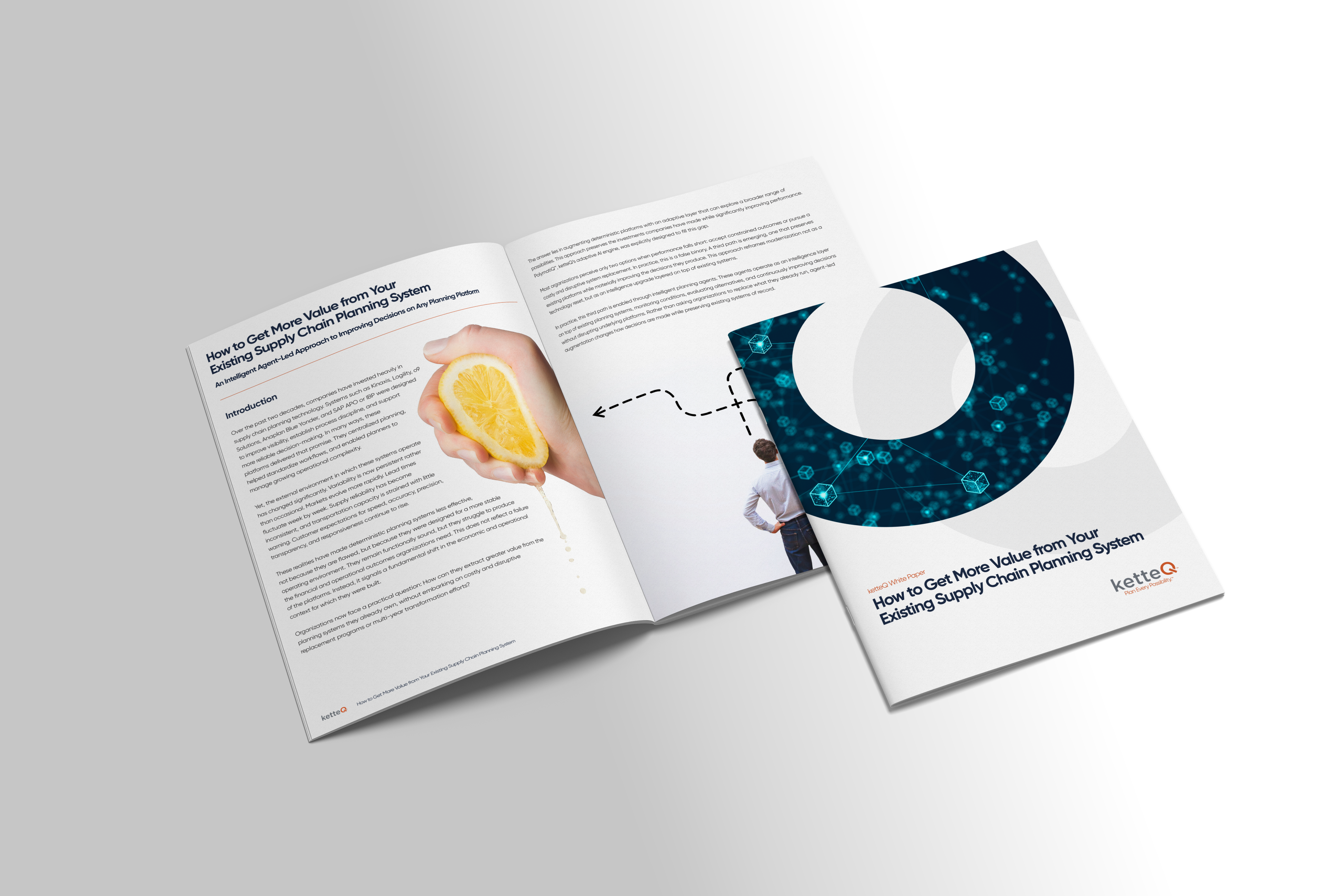
How to Get More Value from Your Existing Supply Chain Planning System
Download the complete guide to explore the approach, the technology, and real-world examples in more detail.
著者について
関連記事

ketteCrew Spotlight: Embracing the Next Era of Planning with Ken Wardlaw
ketteCrew Spotlight: Embracing the Next Era of Planning with Ken Wardlaw