

Inside the Intelligent Supply Chain: Four Capabilities That Change Everything


As supply chains evolve beyond reactive operations, intelligence is no longer defined by faster planning cycles or incremental automation. In 2026, intelligent supply chains operate as continuously adaptive systems. They do not simply produce better plans. They consistently support better decisions as conditions change.
This shift is now achievable because platform architecture, probabilistic modeling, and agentic AI have matured together. Organizations no longer need to choose between stability and adaptability. They can design supply chains that deliver both.
At the core of this evolution are four capabilities that separate intelligent supply chains from traditional planning environments.
1. Continuous Sensing Across the End-To-End System
Intelligent supply chains begin with continuous sensing. Instead of relying on periodic data refreshes or static snapshots, they maintain an always current view of demand, supply, inventory, capacity, and financial performance.
This capability fundamentally changes how organizations experience volatility. Signals are detected as they emerge rather than weeks later during the next planning cycle. Demand shifts, supplier constraints, and capacity changes surface earlier, creating more time and more options.
Continuous sensing does not mean flooding teams with data. When implemented on an end-to-end platform, signals are contextualized so leaders understand what is changing and why it matters. The result is fewer surprises and stronger shared awareness across functions.

2. Probabilistic Reasoning Instead of Single Forecasts
Traditional planning environments depend on point forecasts and deterministic assumptions. Intelligent supply chains replace this approach with probabilistic reasoning.
Rather than asking whether a forecast is correct, leaders can evaluate ranges of outcomes and their likelihoods. This enables decisions that account for uncertainty explicitly instead of hiding it behind averages.
Probabilistic reasoning removes false precision from decision-making. Leaders gain confidence without waiting for certainty that never arrives. They can act earlier because risk, upside, and trade offs are visible and quantified.
PolymatiQ™, the agentic AI engine at the core of the ketteQ platform, is purpose-built for this type of reasoning. It evaluates uncertainty directly, helping organizations identify decisions that perform well across many plausible futures rather than optimizing for a single expected case.
3. Multi Scenario Evaluation at Scale
Probabilistic thinking becomes truly powerful when paired with multi-scenario evaluation. Intelligent supply chains continuously explore thousands of possible futures, examining how decisions hold up as conditions vary.
This capability transforms decision-making from reactive to proactive. Leaders are no longer limited to comparing one plan against another. They can see trade-offs before committing and understand where flexibility creates advantage.
Multi-scenario evaluation also improves cross-functional alignment. When sales, operations, finance, and supply chain teams evaluate the same scenarios on a shared platform, discussions shift from debating assumptions to choosing trade-offs. Alignment emerges naturally because everyone is working from the same set of possibilities.

4. Adaptive Execution Powered by Agent-Led Systems
The final capability that defines intelligent supply chains is adaptive execution. Decisions do not remain static once they are made. As conditions change, intelligent systems continuously reassess whether current actions still align with strategic intent.
This is where agent-led systems play a critical role. Agents operating within PolymatiQ continuously monitor conditions, evaluate alternatives, and surface decision-ready options when adjustments are warranted. They do not replace human judgment. They augment it.
Planners and executives remain accountable for decisions. Agents handle complexity at scale by exploring options, quantifying trade-offs, and presenting clear choices. Humans focus on intent, priorities, and strategic direction.
Adaptive execution reduces organizational friction. Instead of waiting for the next planning cycle or triggering manual interventions, the system maintains alignment dynamically. Plans evolve as reality changes while remaining grounded in executive objectives.
Why These Capabilities Require an End-To-End Platform
These four capabilities only deliver their full value when implemented on an end-to-end platform. Intelligence does not emerge from isolated optimizations. It emerges from understanding how decisions propagate across the supply chain.
ketteQ was designed with this principle at its core. The platform connects demand, supply, inventory, fulfillment, and financial outcomes on a shared data model. PolymatiQ operates on top of this foundation, enabling agents to reason across the entire system rather than within functional silos.
This architecture supports an augmentation-first adoption path. Organizations can layer intelligence on top of existing systems, accelerate time to value, and evolve toward deeper autonomy over time. The result is practical intelligence that delivers results quickly without forcing disruptive change.
What Good Looks Like in Practice
An intelligent supply chain is not defined by how advanced the technology appears. It is defined by how confidently leaders can make decisions under uncertainty.
When these four capabilities are in place, organizations move faster without rushing. They align more easily without constant reconciliation. They respond earlier without overreacting. Most importantly, they operate with clarity even when the future is uncertain.
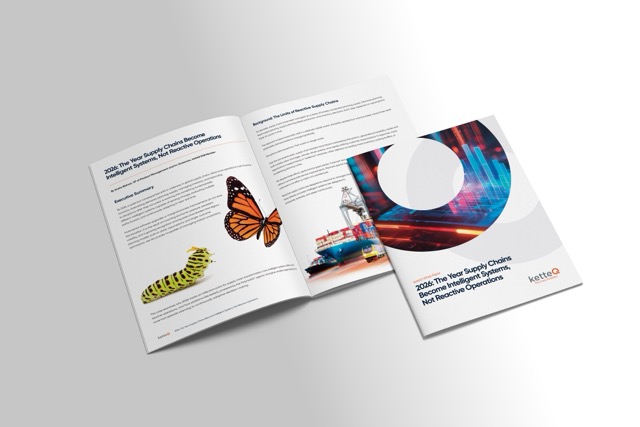
Read The Full Guide
Download and read the full guide, 2026: The Year Supply Chains Become Intelligent Systems, to explore how leading organizations are redesigning supply chains for continuous adaptation, clearer trade offs, and confident decision making under uncertainty.
著者について
関連記事

ketteCrew Spotlight: Embracing the Next Era of Planning with Ken Wardlaw
ketteCrew Spotlight: Embracing the Next Era of Planning with Ken Wardlaw