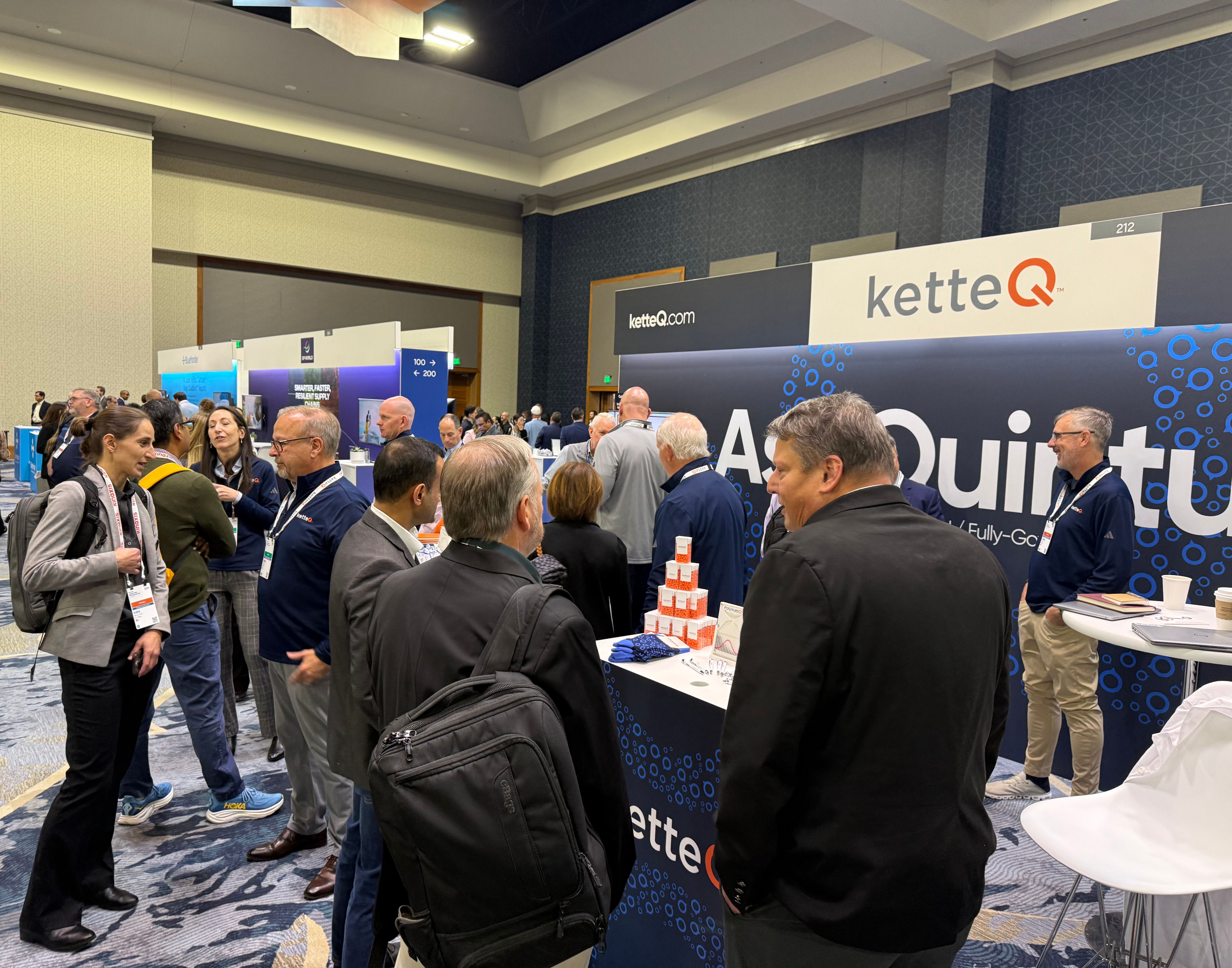

7 Gartner Supply Chain Planning Summit 2026 Takeaways


Seven themes emerged from Gartner Supply Chain Planning Summit 2026: faster decisions, focused AI deployment, governed autonomy, rapid scenario analysis, financial trade-offs, evolving planner roles, and practical adoption. In ketteQ’s customer panel, Johnson Controls reported automating approximately 80% of forecast exceptions, while Zeus described reducing a network budgeting exercise from months to days.
Supply chain leaders have more data, more technology, and more AI available to them. The challenge is turning those resources into decisions that improve business performance.
That question ran through the November 2–3 conference in Denver. The opening keynote, “The Planning Illusion: Escaping the Certainty Trap,” challenged familiar assumptions about planning improvement, emphasizing decision velocity, decision quality, and decision adoption.
At ketteQ, we see those priorities reflected in the challenges our customers are addressing. During our panel with leaders from Lumen Technologies, Johnson Controls, and Zeus, the discussion connected the conference themes to practical experience: managing exceptions, evaluating complex manufacturing choices, and building trust in new ways of working.
1. How can supply chain leaders make better decisions under uncertainty?
Supply chain leaders can make better decisions under uncertainty by identifying critical decisions, evaluating multiple possible outcomes, and establishing clear triggers for action rather than waiting for perfect information. Supply chain teams cannot resolve every unknown before making a decision. Demand shifts, constraints emerge, and assumptions change while the business continues to operate.
The keynote emphasized identifying the decisions that matter, establishing meaningful triggers, and empowering people to respond. Timing matters: some choices require immediate action, while others benefit from preserving options before committing.
For ketteQ, that reinforces the purpose behind Plan Every Possibility™. Planning should help teams explore alternatives, understand the consequences, and respond as conditions change.
A practical starting point is one recurring decision that takes too long. Identify what triggers it, who owns it, and what delay costs the business.
2. Where should companies start with agentic AI in supply chain planning?
Companies should start deploying agentic AI in supply chain planning by identifying a recurring, measurable problem with clear decision boundaries. High-volume forecast exceptions are one practical starting point because teams can measure improvements in efficiency and manual effort.
The conference discussions encouraged organizations to define the decision before selecting the technology. Frequency, complexity, consequences, and readiness should determine the appropriate capability.
Johnson Controls offered a concrete example. Executive Director - Global Parts Planning Akhil Tipnis described starting with repetitive, measurable forecast exceptions within clear boundaries. He reported that AI now automatically handles approximately 80% of those exceptions, freeing analysts to investigate more substantive issues.
That is a useful model for adoption. Begin where the work is understood and the outcome can be measured. Give planners a meaningful improvement in their day, then use the evidence to guide expansion.
3. How can companies build trust in autonomous AI agents?
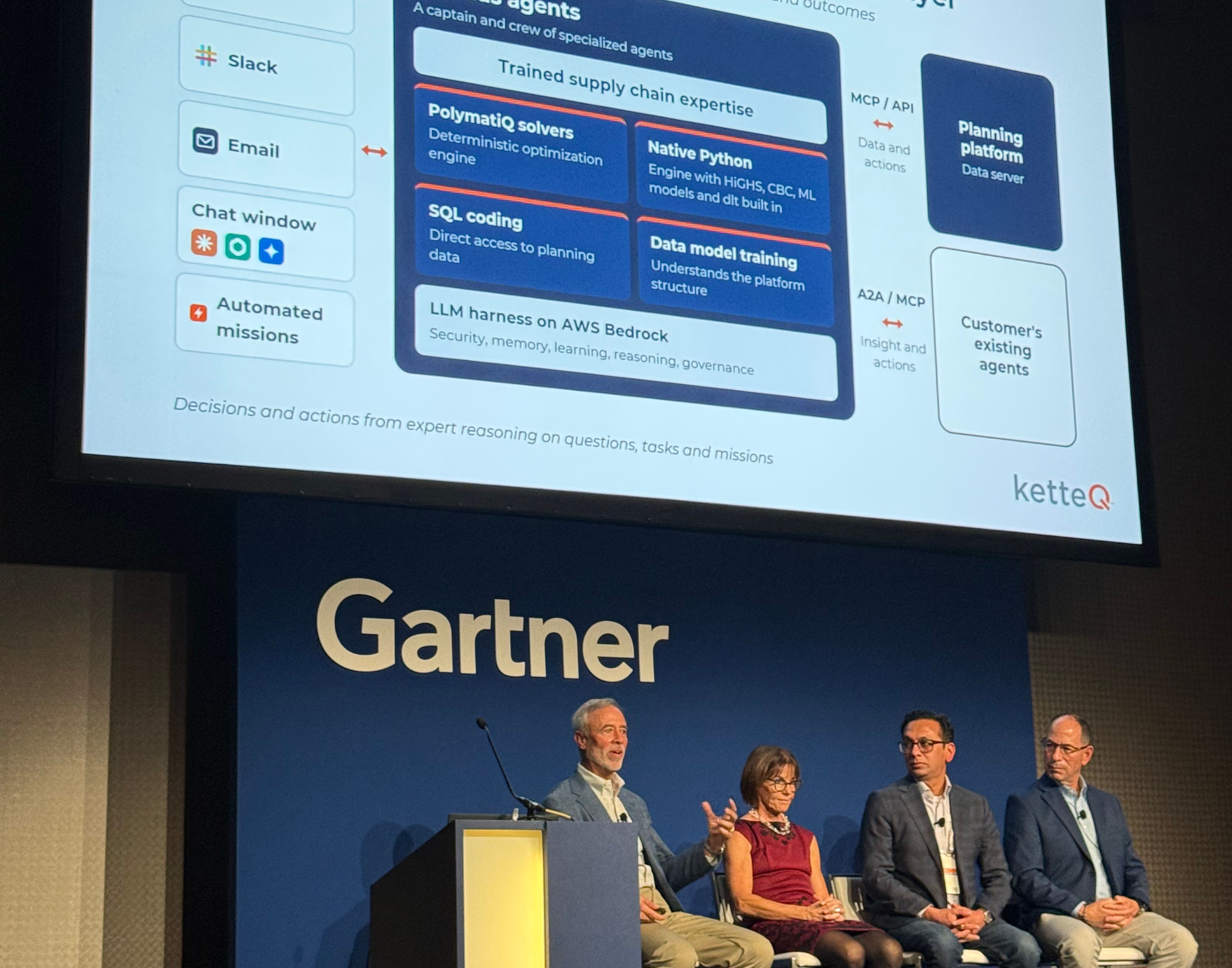
Companies build trust in autonomous AI agents through clear decision boundaries, explainable recommendations, defined approval processes, and ongoing human oversight. AI should earn greater autonomy through demonstrated performance, not receive unrestricted authority from the start.
Trust develops when teams understand what AI can do, where its authority ends, and how performance is evaluated.
The sessions on governance emphasized clear ownership, explainability, escalation paths, and oversight appropriate to the decision. JCI’s experience illustrated that progression: its agents initially operated within tight boundaries, which were gradually expanded as confidence developed.
At ketteQ, Quintus™ brings agentic AI to supply chain planning and orchestration. Its guiding principle is Free-Range AI™. Fully Governed. The technology is designed to support intelligent decisions while maintaining appropriate controls and human oversight.
The opportunity is to give AI room to support business objectives within established controls. Leaders should define those controls before deployment and expand responsibility based on demonstrated reliability.
4. How does AI improve supply chain scenario planning?
AI improves supply chain scenario planning by helping teams evaluate more feasible alternatives, understand operational constraints, and compare trade-offs quickly enough to influence business decisions.
Scenario planning becomes more valuable when teams can evaluate alternatives quickly enough to influence the outcome.
PolymatiQ™ is ketteQ’s multi-pass optimization solver for evaluating planning alternatives. At Zeus, Vice President, Global Supply Chain Tony Balliro described using it to evaluate complex manufacturing scenarios in minutes. He also reported that a network budgeting exercise that had taken months the previous year took days this year.
For ketteQ, this is a practical expression of adaptive planning: helping teams examine more options and understand the implications for capacity, service, and cost.
The goal is to make scenario analysis part of how the business makes decisions. Leaders need time to test assumptions, compare alternatives, and challenge a recommendation before committing resources.
5. How can supply chain planning improve financial decision-making?
Supply chain planning improves financial decision-making by connecting operational choices to their consequences for revenue, capacity, inventory, service, cost, and margin. Leaders need to understand not only what a plan recommends, but what each alternative means for the business.
A growth target does not explain how the organization will achieve it. Additional revenue may require capacity investment, more inventory, different sourcing choices, or changes to the product mix. Planning needs to make those requirements and trade-offs visible.
The sessions on financial discipline emphasized the importance of resolving choices while the business still has options.
Lumen’s Chief Procurement Officer & SVP Supply Chain Shellie Molina described component lead times extending from three months to 18–24 months, with additional suppliers introducing more planning complexity. She identified richer scenario analysis across supplier timing, cost, and margin as an important next capability.
For leaders, the implication is clear: bring alternatives into the discussion with their business consequences attached.
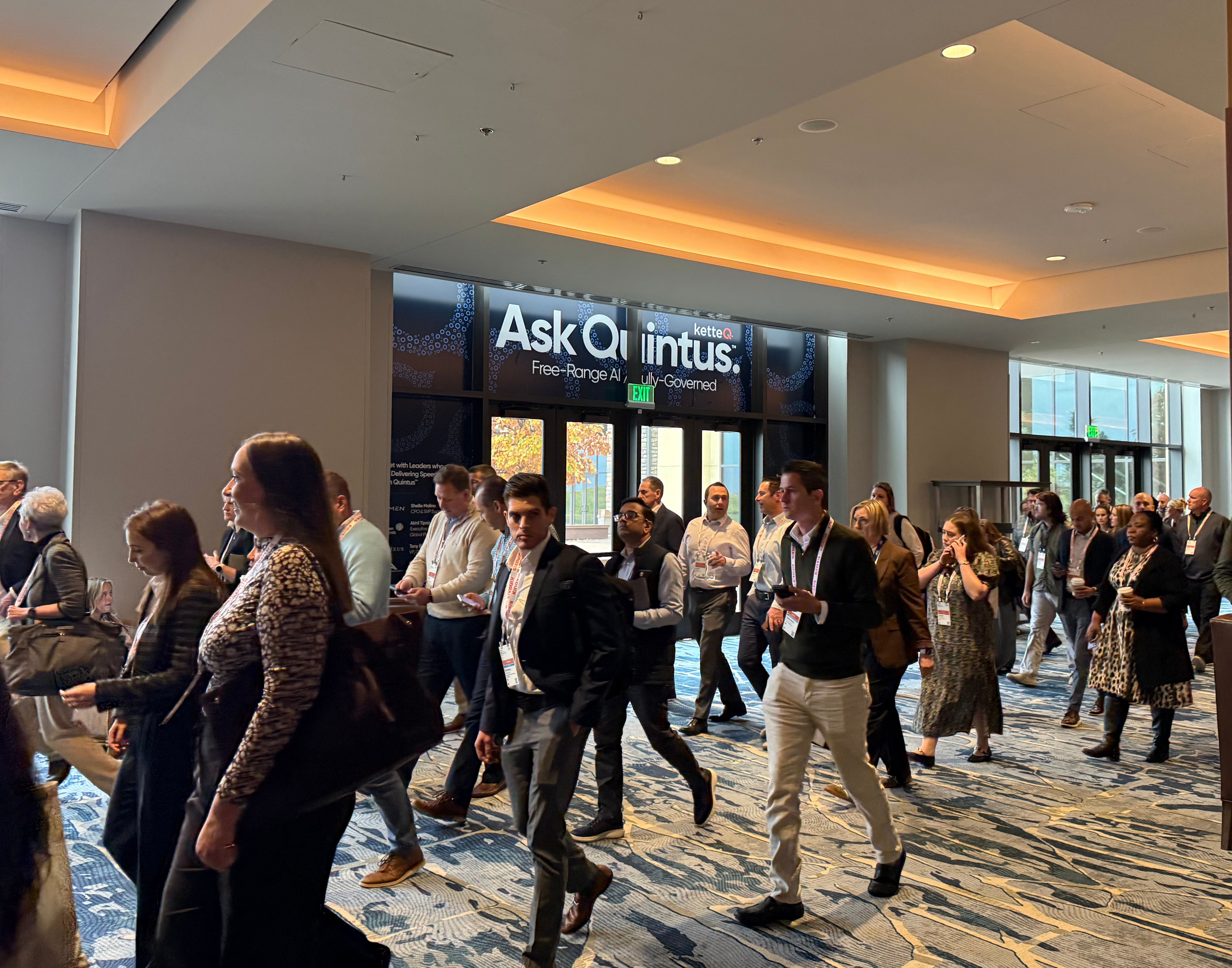
6. How is agentic AI changing the role of supply chain planners?
Agentic AI is shifting the role of supply chain planners away from repetitive analysis and exception processing toward judgment, scenario evaluation, cross-functional collaboration, and decision orchestration.
As AI takes on more routine work, planners need stronger capabilities in critical thinking, business acumen, collaboration, and evaluating system recommendations.
The sessions on evolving planning roles also cautioned against expanding responsibilities beyond what teams are equipped to manage. Broader accountability requires deliberate development and continued access to specialized expertise.
Several live Quintus users showed where that evolution could lead. ACG and NCR Voyix described how they are training Quintus with skills and setting missions that run automated processes to increase their productivity and faster response time.
That direction extends planning intelligence into the work required to carry out a decision. People remain essential to setting priorities, evaluating trade-offs, and managing exceptions.
7. How can companies adopt AI-native planning without replacing existing systems?
Companies can adopt AI-native planning incrementally by starting with a high-value use case, establishing clear ownership and measurable outcomes, and adding intelligent capabilities to existing systems where appropriate. A complete platform replacement is not always necessary.
Transformation needs a manageable starting point, clear ownership, and a path to sustained value.
Lumen’s implementation experience brought that into focus. Molina said ketteQ was selected on January 15 and met the May 4 spares-planning go-live.
The broader adoption sessions reinforced the work that follows deployment: coaching teams, maintaining assumptions, reviewing decisions, and improving processes.
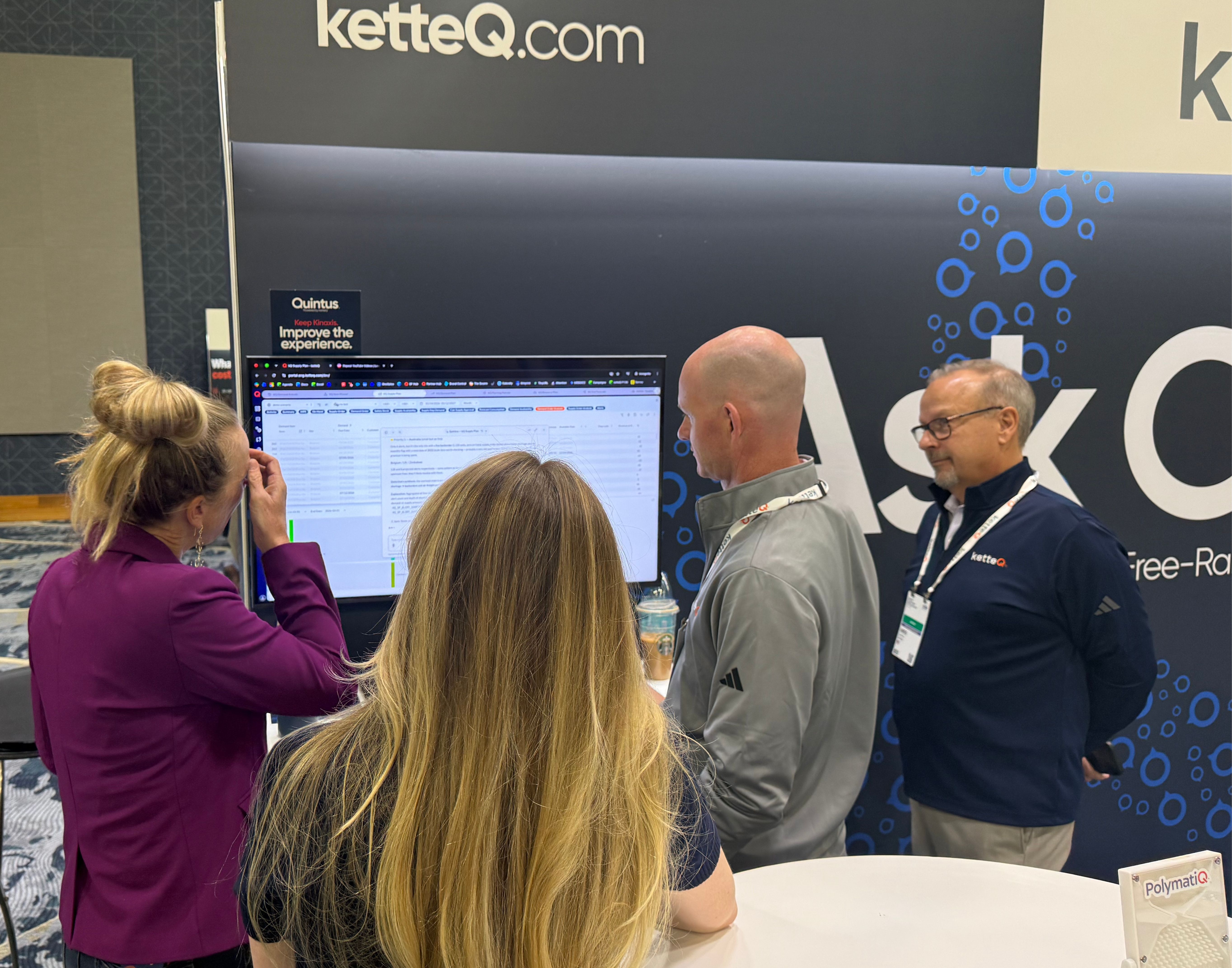
Organizations also have different starting points. Some need a new planning platform. Others want to improve the capabilities of systems already in place. At Lippert, ketteQ deployed Quintus on top of Kinaxis in days, improving the experience and outcomes while building on the company’s existing planning investment.
At the Summit, ketteQ introduced its Keep Kinaxis offer as one path to putting Quintus to work alongside an existing planning investment. The starting point should reflect the business problem, the organization’s readiness, and the value it can demonstrate.
Putting the takeaways to work
Our strongest takeaway from Denver is that planning improvement needs to be visible in everyday decisions.
Can the team evaluate alternatives sooner? Resolve a trade-off with greater confidence? Spend less time chasing routine exceptions? Connect a decision to the actions required to deliver it?
Those are the questions shaping our approach at ketteQ. Quintus brings agentic intelligence to that work, supported by the scenario exploration capabilities of PolymatiQ and a commitment to governed autonomy.
Choose one decision that repeatedly costs the business time, service, or margin. Define the outcome, establish ownership, and measure what improves.
To explore how Quintus can support your planning priorities, connect with ketteQ.
著者について
関連記事

4 Capabilities Every AI-Native Supply Chain Platform Needs
4 Capabilities Every AI-Native Supply Chain Platform Needs